The largest AV company on earth just told the federal government that you do not have to use it. That sentence is sitting in its IPO filing right now, and it changes how you should sign your next venue contract.
Run the math on a $200,000 in-house AV invoice. At a 40% commission, $80,000 of what you pay can flow straight back to the hotel. It buys your audience nothing. Here is how the arrangement works, and how to stop paying for it.
If you have ever stared at an in-house AV quote and wondered why a few screens, some speakers, and a couple of technicians cost as much as a luxury car, this is for you. The choice between in-house AV vs outside AV is one of the highest-leverage decisions on any event budget, and most executives make it without the one piece of information that changes the math entirely.
Key takeaways:
- Hotel in-house AV providers are economically aligned with the venue, not with your event, because their contracts are built on commissions paid back to the hotel.
- You are almost never required to use the in-house provider for your event. The largest one, Encore, confirms this in its own SEC filing.
- In-house pricing runs high because a hotel commission, often 30% to 50% of the invoice, is baked in before anyone turns on a light.
- The deeper risk is not price. It is talent and continuity: who actually produces your show, and whether the same team comes back next year.
- Your leverage is highest before you sign the venue contract. Get an outside number first, every time.
The Setup Most Executives Never Question
Here is how it usually goes. You sign a venue contract for your annual conference or sales kickoff. Somewhere in the paperwork, the hotel introduces you to its on-site AV provider. The quote arrives bundled, branded, and framed as the path of least resistance. Use us, it implies, because we are already here and we know the room.
Convenience is real, and so is the pressure. The quote arrives, it is large, and the clock is ticking. Most teams sign because fighting it feels like a distraction from the hundred other things on the run of show.
What almost no one asks is the question that actually matters: who does this vendor actually work for? You assume the answer is you, because you are the one paying the invoice. The contract structure says otherwise. The in-house provider’s economic relationship is with the hotel, not with your event. That single fact reshapes every number on the page.
What the Encore IPO Filing Actually Says
The company that filed to go public is Encore Inc., formerly known as PSAV. It is the dominant in-house AV provider in the United States and the largest business-to-business live events company in the world by revenue. It is backed by Blackstone, the world’s largest alternative asset manager, it is seeking to raise roughly $500 million, and it intends to trade on the New York Stock Exchange under the symbol ECR.
The scale is enormous: more than 13,000 employees, over 400,000 events a year, roughly 100,000 customers including about 95% of the Fortune 500, across approximately 2,200 venues in 23 countries. It is the on-site AV and production partner inside properties run by Accor, Hilton, Hyatt, IHG, and Marriott. When you walk into a major hotel ballroom in this country, there is a strong chance the AV gear in the corner belongs to this one company. And with its December 2025 acquisition of FIRST, that reach now extends past hotel ballrooms and onto corporate campuses and headquarters, which means even your on-premises company events increasingly run through the same machine.
Now the part that should change how you negotiate. According to Encore’s own S-1 registration statement filed with the U.S. Securities and Exchange Commission, the company signs contracts at each venue that make it the exclusive on-site provider of event technology. To win and keep that exclusivity, it makes up-front venue incentive payments to hotels and structures its agreements around revenue-based commissions that, in the filing’s language, keep the company economically aligned with its venue partners.
Read that again. The economic alignment, by design, is with the hotel. Not with the company hosting the event. The filing also notes that across its contracted venues, Encore captures roughly 80% of the available AV business and views the remaining 20% as growth it intends to pursue harder.
And then there is the sentence that quietly defeats the entire pressure campaign. Encore’s filing states plainly that these exclusive contracts do not preclude outside providers, and that event planners retain the option to use outside AV. The exclusivity prevents another company from being permanently installed in the building. It does not require you to use the house vendor for your event. The largest in-house AV company on earth says so in a federal filing.
Follow the Money: Why the Incentive Runs Against You
Once you understand the commission structure, the pricing stops looking irrational and starts looking inevitable.
Independent industry sources, including AV firms and meeting-planner publications, consistently report that hotels collect a commission of roughly 30% to 50% of the in-house AV invoice, with some accounts citing ranges as high as 40% to 60%. That commission is not a discount the hotel passes to you. It is a cost the vendor bakes into the quote and still clear a profit on top. The higher your AV invoice, the bigger the hotel’s cut, which means everyone on the venue side of the table benefits when your AV bill goes up. That is the conflict, stated cleanly. Your interest is a lean, high-impact show. Their interest is a larger invoice, and a higher sales commission.
Make it concrete. On a $200,000 in-house AV invoice at a 40% commission, $80,000 flows back to the hotel as a kickback. That money does not buy your audience a better screen, a cleaner mix, or a better-run show. It buys nothing anyone can see from a seat in the room.
Consider how strange this arrangement would feel in any other category. You would never accept a home inspection paid for by the seller. You would never trust a financial advisor who earns more the larger and riskier the product they sell you. You would never let the opposing side’s commissioned agent also serve as your buyer’s advocate. Yet that is exactly the arrangement most companies accept on AV without a second thought. The in-house provider is not a neutral expert who happens to be standing in the building. It is a commissioned sales channel for the hotel, and your event is the product being marked up. When the same party that profits from a bigger invoice is also the one writing the quote, “trust us, this is what it costs” is not a number you can take at face value.
This pressure is not easing. After the IPO filing, Alisa Stewart, a senior global event strategist at the agency Maritz, warned that the move could push AV prices higher in an already inflated market, noting that the pricing pressure on groups is intensifying rather than easing. A company answering to public shareholders has one job: grow revenue per event. That goal points in exactly one direction for your budget.
The markup compounds in a few predictable ways:
- Markups on rented gear. In-house vendors frequently do not own all the equipment or staff every technician they bill for. They subrent gear and bring in freelance crew, then add margin on top. You pay a markup on a markup.
- Patch fees and house engineer fees. If you do bring an outside team, expect a charge simply for connecting to house power and rigging, commonly cited in the $500 to $2,000 per day range. These fees exist to make the outside option look worse.
- Opaque invoices. Bundled packages make it hard to see what you are actually paying for, which is exactly the point. Transparency is not in the house vendor’s interest.
None of this means the people running the in-house AV are bad at their jobs. Many are excellent technicians. The problem is structural, not personal. They are paid to serve a business model whose incentives point away from your budget.
Simple vs. Creative: Two Different Businesses Wearing the Same Name
Here is the distinction that gets lost when everything is filed under “AV.” Putting a microphone on a podium and producing a high-stakes general session are not the same business. They only share a name.
The in-house model is built and priced for the first one: the volume business of hotel events. A screen and a speaker in a breakout room. A panel with three wireless lavs. A luncheon with a slideshow. That work is real, it matters, and a capable house technician does it well all day long. If that is genuinely your event, the in-house AV team can be a reasonable, convenient choice, and a good outside partner will tell you so.
Creative production is a different craft. The moment your program includes live camera switching, IMAG on the main screens, video rolled to a presenter’s cue, lower thirds, a scripted run of show, walk-in and walk-out music, presenter management in the wings, and a show caller driving the whole crew on headset, you have left the world of a few mics and a screen. You are running a live broadcast in front of your most important audience, and the margin for error is zero. The keynote does not get a second take. Your CEO does not re-deliver the line because a graphic was late.
So the honest comparison looks like this. In-house can make sense when the event is simple, the stakes are modest, and convenience genuinely outweighs the premium. An outside partner almost always wins when the event is high-stakes, when you want creative range built around your audience rather than in-house, when the budget is under real scrutiny, and when you need a team that treats the show as a single connected experience rather than a list of equipment. In-house is built for convenience and capture. Outside production is built for outcomes. The bigger the moment, the more that distinction costs you.
The A-Team Problem: Who Is Actually Touching Your Show
This is the part almost no quote reveals, and it may be the most important. When the lights go down, your event is only as good as the specific human beings on the headsets and behind the consoles. Not the brand on the invoice. The people.
A volume operator staffs from a roster of technicians who are assigned to whatever is in the building that day. They are generalists by design, because the model runs on coverage and predictability. The same person who set a luncheon this morning may be working your keynote tonight. For a simple production, that is fine. For a flagship event, it means the people executing the most important forty-five minutes of your year may be meeting your content, and each other, for the first time that morning.
An independent production partner works the opposite way. You are not handed whoever is on shift. You bring in your best people for this show. And the best people in live production are not sitting on a salaried roster at a volume operator, because keeping that caliber of talent on full-time payroll across thousands of venues would be wildly expensive. The top freelance specialists go where the top work is produced.
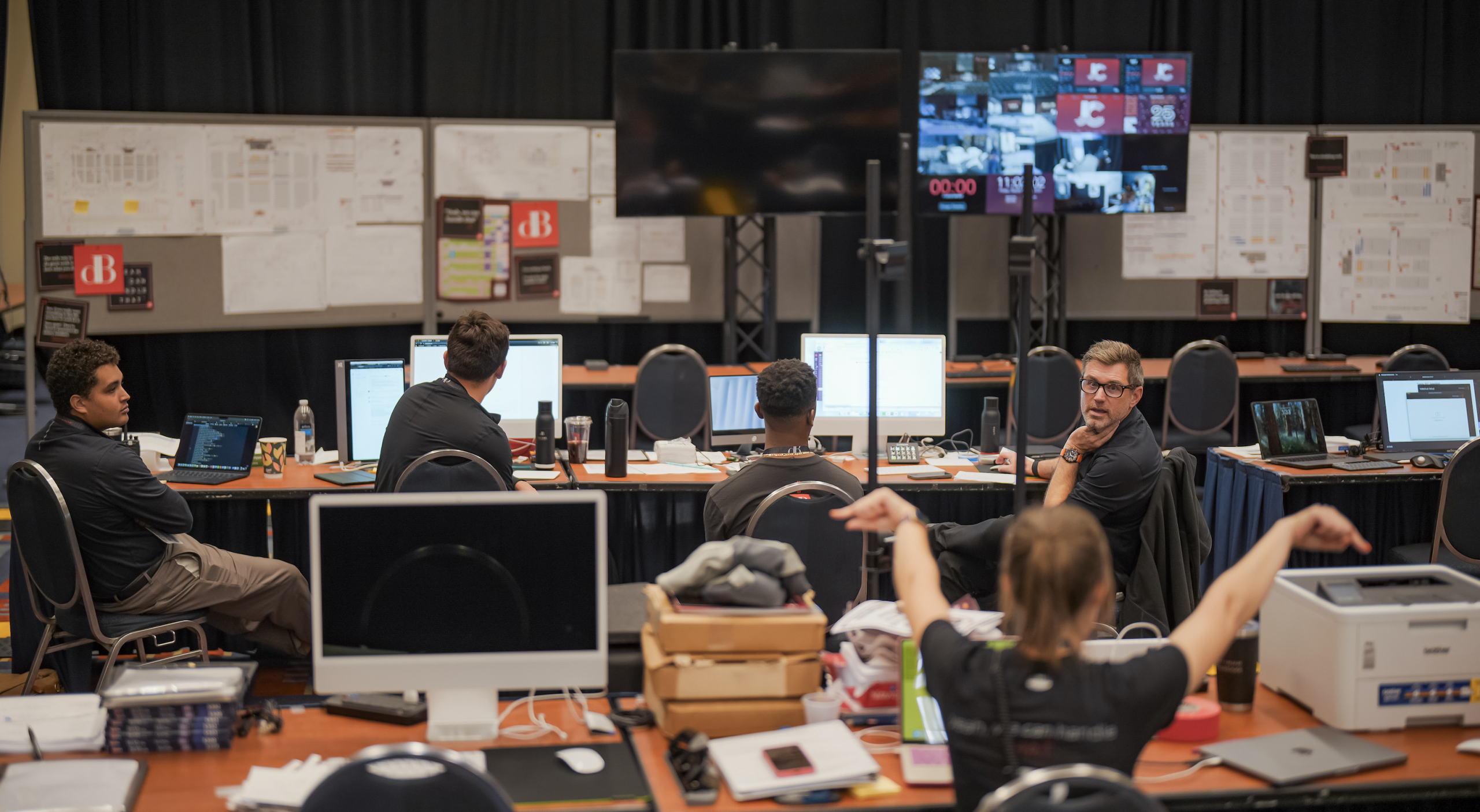
That is the caliber an independent partner can put in your room. On any given high-end production, the crew that Decibel assembles can include technicians who run Super Bowl broadcasts, who tour with artists like John Legend, who build and run stadium-scale shows and major brand spectacles. These are the directors, engineers, and show callers who operate at the highest level of the craft, and they are available to your event precisely because the independent model hires the right specialist for the job rather than defaulting to the nearest available generalist. You are not paying to keep them on a bench all year. You are getting them on the day it counts.
When the stakes are real, that difference is the whole game. The same gear in two different sets of hands does not produce the same show.
Pre-Production Is Where the Show Is Won (and Where In-House Often Falls Off)
Ask any seasoned producer when a show is actually won or lost, and the answer is rarely game day. It is the weeks and months of pre-production that come before it. Pre-production is the invisible work that decides whether your event feels effortless or merely survives: discovery and goal-setting with your team, theme and creative direction, content and graphics development, scripting and the run of show, to-scale stage and room design, rehearsals, vendor and venue coordination, and a contingency plan for the moment something fails. By the time the doors open, a well-produced show has already been run a dozen times on paper and at least once in the room.
This is the single biggest gap in the in-house model, and it is structural. The person who sells you the in-house package is usually a venue salesperson whose job ends when you sign. Pre-production is light by design, because the model is built on volume and on assigning crew close to the event date. You frequently do not meet the people running your show until load-in. Custom creative is limited. The room diagrams you receive are often produced in event-layout tools like Social Tables or Delphi, which are useful for seating and banquet setups but are not to-scale technical drawings of how a stage, rigging, sightlines, and screens actually fit the space.
A dedicated production partner works the opposite way. The producer who will run your show is the one building it with you from the first call. You work in tandem: regular production meetings, a living run of show you both shape, presenter coaching and rehearsals, and CAD drawings drawn to scale so there are no surprises when the truss goes up. That tandem rhythm is where a good partner learns your priorities and removes risk long before anyone is in the room. It is also where the depth of senior, high-end experience shows, and exactly where the convenience of the house desk stops being enough.
One Team, Every City, Every Year
The in-house model has a built-in discontinuity that most companies never name. Change the venue, and you change the entire team. Move your conference from a Marriott in one city to a Hilton in another, and a completely different crew of strangers inherits your show, with no memory of last year, no relationship with your executives, and no idea what is the most important key learning from the last time. Every event is a cold start, and a cold start is a risk.
An independent partner is the opposite. The same team follows you across every property and across every year. That continuity is the value that almost never makes it onto a spreadsheet, and it is one of the biggest reasons sophisticated companies move their production off the house model. The same producer, the same director, the same show caller, and the same technical leads come back already knowing things a new crew cannot possibly know on day one:
- How your CEO likes to be cued, where they drift on stage, and what makes them comfortable under the lights.
- Your organization’s hot-button items, the lines that cannot be missed, and the moments that carry political weight inside the company.
- Your values and your tone, so the look and feel of the show reflects who you are rather than a generic template.
- The cadence of your run of show, the transitions that always run tight, and exactly what almost went sideways last year so it never happens again.
- The shorthand. A team that has worked with your people can communicate in half the words, which is precisely what you want when something has to be solved in ten seconds on headset.
A consistent team does not just stay good, it compounds. Year two is more seamless than year one. Year three is better than year two. The team gets faster, calmer, and more anticipatory, and the production value climbs while the surprises fall away. You can only control that when you own the relationship with your production team, in any city, rather than inheriting whoever the venue assigns this time.
A Partner Who Thinks Past the Gear
The best production partners are not really in the equipment business. They are in the communications business. Your event is not a list of screens and speakers. It is a message delivered to the people who matter most to your company, with your CEO standing in the middle of it. The question is whether the team in the room understands that or just knows how to turn the gear on and squeak by.
This is where deep, senior experience separates a true partner from a vendor. A partner who has spent years in high-stakes communications thinks about the narrative arc of the general session, the reputational risk in a single mishandled moment, the way a room should feel when your chief executive walks on stage, and how the content will live afterward on every channel your audience scrolls. That perspective shapes a hundred small decisions a commodity AV provider never even considers.
It is not an abstract claim. Decibel was founded out of exactly that world. Before launching the company, I built this discipline at FleishmanHillard, one of the largest public relations firms on earth, producing high-profile national programs where the message and the production were inseparable. That communications DNA is why we treat your event as a strategic moment for your brand and your leadership, not a banquet-order line item. The gear is table stakes. The judgment about how to use it is the value.
Who Is the Right Partner for Your Event, Your Company, and Your CEO?
Strip away the noise and the decision comes down to a single question: match the stakes to the partner.
Think about it on three levels at once.
Your event. Is this a simple production or is it your flagship event? A breakout with a screen can survive the in-house AV team. A keynote, a product launch, an investor day, or a televised general session needs a senior, dedicated production team. Be honest about which one you are actually planning.
Your company. Will this event happen again next year, and the year after, in different cities? If so, continuity is worth more than convenience. A partner who follows you across properties and years builds institutional memory that a rotating house crew never can. The recurring program is exactly where an independent partner pays for itself many times over.
Your CEO. This is the one that should settle it. The person on that stage is the face of your company, and the cost of a fumbled moment is measured in reputation, not dollars. When your chief executive is in the spotlight, you want a team that has managed C-suite talent on the biggest stages, that knows your leader, and that has earned the right to be trusted with the most visible forty-five minutes on your calendar. That is not a decision to hand to whoever the venue assigns.
If the answer to any of those is “high stakes,” the convenient choice and the right choice are not the same.
The Move That Saves the Most Money: Get Outside Quotes Before You Sign
Here is the single most valuable thing in this entire post. Your leverage is highest before you sign the venue contract, and it collapses the moment you do.
While the AV quote gets the attention, it is not your real source of power. Your room block and your food-and-beverage spend are. A hotel sales manager is measured on filling rooms and selling catering, not on AV commissions. When you bring a few hundred room nights and a meaningful catering budget, you are a client worth keeping happy, and AV exclusivity becomes a point you can negotiate rather than one you have to accept.
So before you sign anything, do this:
- Ask for the venue’s AV exclusivity language and fee schedule in writing, including any patch fees, house engineer fees, rigging fees, and power or internet charges for outside vendors.
- Get a real quote from an independent production company, for the exact same scope. This number is your benchmark and your bargaining chip.
- Use it. Hotels routinely soften their stance, waive or cap fees, or have their in-house vendor sharpen their pricing when you can credibly show a lower outside number. They would rather keep your room block than lose the booking over an AV quote.
- Get every concession in the contract. Verbal approvals from a sales manager do not survive staff turnover. If a fee is waived, it lives in the signed document or the banquet event order, or it does not exist.
The rule to remember is simple: never sign in-house AV until you have an outside number in hand. Not because the in-house vendor is always more expensive, but because you cannot know whether it is until you have something to compare it to. A second opinion on a six-figure line item is not a luxury. It is basic due diligence.
Red Flags in an In-House Quote
A few signs that the number in front of you deserves a hard second look before you sign:
- A bundled package with no itemization, so you cannot see what each piece actually costs.
- No named producer, director, or show caller, just a promise that a crew will be there.
- “We have never had a problem” offered in place of an actual backup and redundancy plan.
- Room diagrams that are not to scale, produced in a layout tool rather than as a real CAD drawing.
- Pressure to sign the AV commitment inside the venue contract before you have priced it anywhere else.
The Pre-Signature Checklist: Questions to Ask Before You Commit
Print this. Bring it to your next venue walkthrough and your next AV conversation. The answers tell you almost everything you need to know, and the act of asking them changes how you are treated at the table. We have also built a downloadable version you can hand to any provider and have them fill in their answers in writing.
Ask the venue, before you sign the contract:
- Is there an in-house AV provider, and is its use mandatory or preferred?
- What exactly does the exclusivity cover: the building, or my specific event?
- If I bring an outside production company, what fees apply? Get the full list in writing: patch fees, house engineer fees, rigging fees, power, internet, and any supervisor charges.
- Will you waive or cap those fees as part of the room block and food-and-beverage agreement?
- Will you put every concession in the signed contract or banquet event order, not just in an email?
Ask the in-house AV provider:
- Which line items are equipment you own versus gear you are subrenting from a third party?
- Are the technicians on my event your full-time staff, or freelance and shift crew assembled for the day?
- Will I have the same crew for the entire event, including load-in, rehearsal, and show?
- Will the rep selling me this event actually run pre-production and be on-site, or do you hand off to a different team after I sign?
- Will you provide to-scale CAD drawings of the room and stage, or only Social Tables or Delphi diagrams that are not to scale?
- Can you give me an itemized quote rather than a bundled package?
Ask any outside production partner you are considering:
- Do you take any commission, rebate, or referral fee from the venue? (The answer should be no.)
- Will I have the same core team, including producer, director, show caller, and technical leads, year over year?
- Who specifically is calling my show, and how many programs like mine have they run?
- How do you handle the venue relationship, fees, and logistics on my behalf so I am not managing two parties?
- Can you walk the room with me before I sign the venue contract (while you still have leverage)?
Vet the actual team and the pre-production (ask either provider):
- Can you send resumes, a CV, or a credits list for the producer, director, and show caller assigned to my event, with examples of similar shows?
- Can you share a recording of your team on comms during a live show, so I can hear how they actually communicate under pressure?
- How much direct, one-on-one experience does the assigned producer have managing C-suite executives on stage?
- Can you show me sample production paperwork: a run of show, production schedule, labor schedule, and gear list from a comparable event?
- Can you provide references or case studies from events of my size and complexity?
- What is your backup and redundancy plan when a microphone drops or a projector fails mid-session? (“We have never had a problem” is a red flag.)
- How is your pricing structured: cost-plus, hourly, or a management fee? Itemize it so I can compare bids accurately.
- Can you provide a certificate of insurance that meets the venue’s load-in requirements?
If a provider hesitates on the ownership, staffing, pre-production, or commission questions, that hesitation is your answer.
Why “Flat Costs for the Same Experience” Isn’t Realistic
There is a conversation happening in budget meetings everywhere right now, and it deserves an honest answer. Procurement and finance are pushing event teams to hold costs flat year over year while delivering the same experience. It is an understandable ask. It is also not how the math works.
Encore’s own filing puts numbers to the trend. The company reports that average corporate event spend in its core hotel market has risen at a compound annual growth rate of 8% to 10% since 2019, driven by greater complexity, inflation, and a shift toward larger, more immersive experiences. Its own average revenue per U.S. event climbed from $8,300 in 2023 to $9,000 in 2024 to $9,700 in 2025. Labor, freight, equipment, insurance, and power have all moved in the same direction. Holding a budget flat in that environment is, in real terms, a budget cut.
The goal cannot be the same show for less money. The realistic and far more powerful goal is more show per dollar. And that is exactly where the in-house AV vs outside AV decision pays off. Every dollar you stop paying in hotel commission is a dollar you can redirect to what your audience actually sees and feels: the screens, the staging, the content, the moment. You are not freezing the budget. You are removing a tax that was buying your attendees nothing and putting that money back into the experience.
Framed that way, the question stops being “how do we spend less” and becomes “how do we make sure every dollar lands on stage instead of in a commission.” That is a question a good production partner is glad to answer.
How Decibel Events Approaches AV Procurement
At Decibel Events, the problem we refuse to accept is simple: an event budget quietly taxed by commissions that buy the audience nothing. We believe every dollar a client spends should benefit the experience, not in a kickback structure the client never sees. So we built an independent corporate event production company with no hotel commission arrangements working against you. Our loyalty has one direction, and it points at your outcome.
That independence is the whole point. Because we are not the in-house vendor, we have no incentive to inflate an invoice, and no reason to steer you toward gear you do not need. We give you an honest outside number, we tell you the truth about when in-house genuinely is the smarter call, and we design the production around your audience rather than a venue’s catalog. We bring in the best specialists in the business for your show, the same caliber of talent that runs the biggest stages in the world, and the same core team comes back for you year after year, in any city. With 17 years of producing high-stakes corporate events and senior leadership hands-on for every single one, we sit on your side of the table from the first walkthrough to the final load-out.
“The Decibel team consistently proves themselves as top-notch professionals. Having Decibel on board always streamlines my job, making it a seamless experience.”
T.W., Fortune 500 industrial technology company
When Decibel delivers, you stop being the executive defending a bloated AV line in a budget review. You become the one who reallocated six figures to the main stage and made the whole program better for it.
Before You Sign, Get a Second Number
The next time a venue hands you an in-house AV quote, do not sign it for convenience. Treat it like any other six-figure decision and get a second opinion. An honest, independent number tells you whether the house price is fair, and it gives you the leverage to negotiate if it isn’t. That single step routinely protects more budget than any other move in the planning process.
Decibel Events will give you that number, straight, with no venue commission pulling on the math. Get in touch with our team before your next venue contract is final, and let’s make sure every dollar lands on the stage.
Frequently Asked Questions
Do I have to use the hotel's in-house AV company?
In almost all cases, no. Hotel contracts typically grant the in-house provider exclusivity over being permanently installed in the venue, not over your individual event. Even the largest in-house AV company, Encore, states in its own SEC filing that event planners retain the option to use outside providers. You may face a fee for bringing your own team, and that fee is negotiable, especially before you sign.
How much commission do hotels make on in-house AV?
Industry sources consistently report that hotels collect roughly 30% to 50% of the in-house AV invoice as commission, with some accounts citing ranges up to 60%. That commission is built into your quote, which is a primary reason in-house pricing tends to run higher than independent providers for the same scope.
Is outside AV cheaper than in-house AV?
Frequently, yes, for comparable scope, because outside providers are not funding a hotel commission. Reported savings vary, and planner sources commonly cite outside bids coming in around 20% lower for the same setup. The only way to know your number is to get an outside quote and compare it directly to the in-house proposal before you commit.
What is a patch fee or house engineer fee?
It is a charge some venues apply when you bring an outside AV company, ostensibly to cover connecting to house power, rigging points, or internet, or to staff a venue supervisor. These fees commonly fall in the $500 to $2,000 per day range and are negotiable. Ask for the full fee schedule in writing and negotiate it down or away before signing the venue contract.
Are in-house AV technicians full-time employees?
Often not entirely. In-house providers frequently supplement full-time staff with freelance and shift crew assembled close to the event date, and they subrent equipment they do not own. Ask directly whether the specific technicians on your event are full-time staff and whether you will have the same crew through load-in, rehearsal, and show.
Who actually works on an independent production crew?
A strong independent partner staffs each show with the right specialists for the job rather than whoever is on shift. Because top live-production talent is freelance and goes where the top work is, an independent crew can include technicians who work major broadcasts, world tours, and stadium-scale productions, brought in specifically for your event. You get that caliber on show day without paying to keep it on salary year-round.
Why does using the same production team every year matter?
Continuity is one of the most underrated risk-mitigation tools in corporate events. When the same producer, director, show caller, and technical leads return year over year and follow you from city to city, they already know your executives, your values, your hot-button items, and the cadence of your run of show. The show compounds: each year is more seamless than the last. A rotating house crew starts from zero every time and in every new building, which makes every event a cold start and a hidden risk.
What is Encore, and why does it matter to me?
Encore Inc., formerly PSAV, is the largest in-house AV and live event production company in the world, backed by Blackstone, with about $3.4 billion in 2025 revenue. It is the exclusive on-site provider at roughly 2,200 venues, including properties run by Accor, Hilton, Hyatt, IHG, and Marriott. It matters because its business model, disclosed in its 2026 IPO filing, is built on revenue-based commissions paid to hotels, which means the vendor in your ballroom is economically aligned with the venue, not with your event.
Why do corporate event costs keep rising every year?
Inflation, rising labor and freight costs, and a steady shift toward larger, more immersive productions all push event spend up. Encore’s filing reports core-market corporate event spend rising 8% to 10% per year since 2019. Asking to hold costs flat while keeping the same experience is, in real terms, a cut. The more practical lever is removing commission-driven markups and redirecting that money into the parts of the show your audience actually experiences.

About the Author
By David Sonntag, CEO & Executive Producer, Decibel Events
David Sonntag is the CEO and Executive Producer of Decibel Events, a full-service event production, design, and management company headquartered in Washington, DC. He has been producing live events since 2003, including on the National Mall and with the National Park Service. For more than 14 years, David has served as the event producer for the Library of Congress National Book Festival.
He is also a former Vice President at Fleishman-Hillard, where he gained extensive experience in message development and delivery.
David’s expertise spans technical production, event design, event management, and marketing communications. His events have earned seven Silver Anvil Awards, eleven Telly Awards, two PR Week Awards, and many other industry honors. The Triangle Business Journal also selected David for the 40 Under 40 Leadership Awards in 2017.
Under David’s leadership, Decibel Events has been continuously listed on the Washington Business Journal’s Largest Meeting and Event Planners ranking every year since 2019. To learn more or discuss your next event, contact David at David@DecibelEvents.com or 703.953.4493.