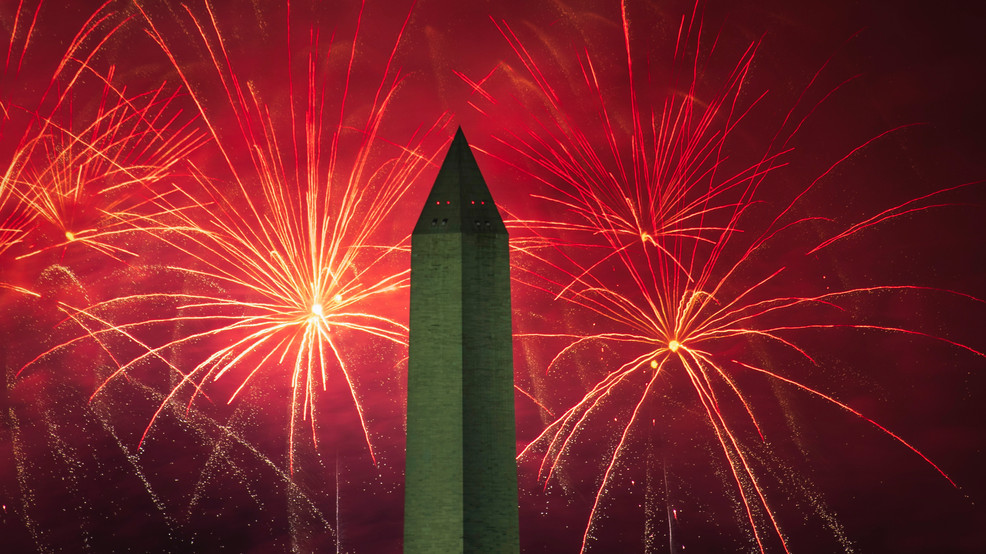
On the night of July 4, 2026, Washington is going to attempt something no city has ever pulled off: roughly 850,000 fireworks in a single display. That is not a typo. A normal Fourth on the National Mall runs somewhere between 17,000 and 20,000 shells across about 17 minutes. This year’s Salute to America is built for 40 minutes and a Guinness World Record.
We want to be clear up front: Decibel Events is not producing this show. We are watching it the way any Washington DC production company watches a once-in-a-generation build, with real excitement and a professional eye on the logistics most people will never notice. We have worked with Pyrotecnico on productions before, and we know a little about what a night on this scale actually demands.
So let’s go behind the numbers: what the figures really mean, and what it takes to put that much into the sky over a secured Mall.
The Numbers, Decoded
The headline figure keeps moving depending on the source, landing somewhere between 850,000 and 860,000 shells. Either way, the scale is hard to picture, so a little context helps.
The show most Americans think of as the biggest is Macy’s over the East River. The American Pyrotechnics Association pegs a typical Macy’s show at 60,000 to 85,000 aerial shells and effects. This year’s DC display is aiming for roughly ten times that. The mark to beat is the current world record set in Manila in 2016, which used more than 810,904 fireworks. In other words, organizers are not trying to top Macy’s. They are trying to top the planet.
One detail we love, because it is pure production thinking: the largest shells will still be 10 inches, the same size DC has used in prior years. On a footprint as tight as the National Mall, safety codes cap how big a single shell can be. So the record is a volume-and-choreography challenge, not a bigger-shell challenge: more shells, spread across a much longer runtime. That is a very different and much harder thing to pull off.
Ten Launch Sites, Eight Barges: The Part Nobody Sees
Here is where a spectator sees magic and a producer sees a logistics chart.
The fireworks are being fired from ten separate sites: the Lincoln Memorial Reflecting Pool, West Potomac Park, and eight barges floating on the Potomac River. Ten firing locations is not ten times one show. It is a single, unified sequence that will be one continuous experience from the ground, which means every one of those sites has to be synchronized to the same clock, the same music, and the same creative arc.
Getting eight barges positioned, anchored, loaded, and wired on a working river is its own operation before a single shell goes up. Add the land-based sites, the cabling, the firing systems, and the redundancy you build in when there is no second take, and you start to appreciate the scale of the operation and the pre-production behind those 40 minutes.
Then there is smoke. On a humid Washington night, spent smoke can hang in the air and wash out everything behind it. Part of the reason for stretching the show to 40 minutes is giving time between each sequence to allow for the smoke to clear before the next one fires. That is a creative choice and a weather bet at the same time, the kind of call that separates a produced show from a pile of fireworks going off.
Producing Inside a National Special Security Event
This is what turns a big show into a genuinely complex one, and it is the part closest to our own work.
The Salute to America has been designated a National Special Security Event, led by the U.S. Secret Service. For anyone who has not produced inside one, that designation changes everything about how you operate. Security magnetometers for the public open at 1 PM. Attendees move through airport-style screening, with a clear-bag rule and a long list of prohibited items, and there is no on-site storage, so whatever you surrender at the checkpoint is simply gone.
The public sees a slow line at the gate. Behind it sits a locked-down site plan that reshapes everything else. Credentialing, vehicle access, load-in windows, and comms all bend around the security perimeter rather than the other way around. You cannot just send a truck in when you need one. You plan the entire build against access rules that are not yours to set, and you build in the margin to absorb whatever those rules do to your timeline.
For a corporate event production company that works in Washington DC, none of this is exotic. It is a normal Tuesday. Protective details, screening perimeters, and federal calendars are the standard operating conditions here, and learning to produce a flawless show inside them is a large part of what DC event production actually is.
The Immovable Date
Every producer reading this already feels the thing that makes this show so demanding, and it has nothing to do with the shell count.
You cannot move July 4. There is no rain date on the nation’s 250th birthday. The forecast is calling for extreme heat, air quality is expected to degrade as the smoke builds, and the whole thing is live, nationally visible, and one shot only. There is no version where the crew gets a do-over on Monday.
That is the exact pressure profile of the events we work on: a hard date, a live audience in the hundreds of thousands, national visibility, and zero margin for a reset. It is also why the real skill in production lives underneath the part the audience sees, in the planning that makes the visible stuff happen on time, on the one night it has to.
What We'll Be Watching For
We get asked this every time a show this big comes up. Beyond enjoying it like everyone else, here’s what our team will actually be watching on the Fourth.
We will be watching the transitions between the ten firing sites and the sync between them. Smoke management across a 40-minute runtime on a humid night is its own test, and we are hopeful that there is enough breeze to clear it for a great show. It will be awesome to see how they handle the pacing. Sustaining energy for 40 minutes without a lull is far harder than a punchy 17-minute show that just builds to a finale. And we will absolutely be watching the finale, because closing a record-setting show is a creative challenge, it’s not just about volume.
Mostly, though, we will be watching the way producers watch any show: looking forward to the show without being able to turn away from the production.
How Decibel Approaches High-Stakes DC Production
We are not a fireworks company, and we are not behind this show. But the reason a night like this fascinates us is that it is a scaled-up version of the work we do every year: high-visibility, high-stakes production in Washington DC, executed inside security overlays, against timelines that can not be rescheduled.
Producing inside a security overlay is something we know well. A few months back we wrote about the disciplines that separate a real event security plan from security theater, drawn from 17 years of federal and association work, and the same principles scale all the way up to a night like this one.
For 17 years, Decibel Events has produced corporate events, conferences, and activations for Fortune 500 companies, national associations, and federal agencies in exactly this environment. That is corporate event production, and it is a very different discipline from event management.
When the stakes are that high, you want a partner who has been in the room before. Or, as we tend to put it: yeah, we can handle that.®
How many fireworks will be launched at the 2026 DC fireworks show?
Organizers are planning to launch roughly 850,000 to 860,000 fireworks. That is about ten times the size of a typical Macy’s Fourth of July show and enough to break the current world record of more than 810,904, set in Manila in 2016.
Who is producing the 2026 Salute to America fireworks?
The show is being produced by Pyrotecnico, a Pennsylvania-based pyrotechnics company known for large-scale productions including Super Bowl displays. Decibel Events is not involved in producing this show, though we have worked with Pyrotecnico on other productions.
Where are the fireworks being launched from?
The display will fire from ten sites: the Lincoln Memorial Reflecting Pool, West Potomac Park, and eight barges positioned on the Potomac River. Coordinating a single continuous show across ten separate firing locations is one of the biggest production challenges of the night.
What time do the DC fireworks start on July 4, 2026?
The start time has moved around during planning. Organizers and DC officials, including the Mayor’s office, now point to around 10:30 PM, well after the National Mall’s traditional 9 PM launch. Plan for a late night and confirm the official time before you head out, since details have been shifting right up to the holiday.
Why is a fireworks show like this so complex to produce?
Scale is only part of it. The show has to synchronize ten firing sites into one continuous sequence, manage smoke across a 40-minute runtime, and operate inside a National Special Security Event with airport-style screening and a locked-down site plan. On top of that, the date cannot move and the show is live, so there is no second take.
Even the best in the business feel that pressure. Back in 2012, San Diego’s Big Bay Boom, a well-run and professionally produced show, had a data file corrupt moments before launch, and all 7,000 shells meant for an 18-minute display went up in roughly 15 seconds. No one was hurt, the crew was fine, and the show came back stronger in the years since. But it is a great reminder of how thin the margins really are on a night like this, even for teams who do it for a living.
What is the difference between event production and event management?
Event management generally covers logistics like venue, catering, and scheduling. Event production is the technical and creative execution of the event itself: staging, audiovisual, show calling, content, and the live run of show. Decibel Events is a corporate event production company, which means we build and run the show, not just plan around it.
Watching the Fourth With Us
We will be out there on the Fourth like everyone else, watching the sky over the Potomac and paying close attention to the logistics behind it. If your organization is planning an event where the date cannot move, the audience is important, and the execution has to be flawless the first time, that is the work we do every day in Washington DC. Reach out to our team at decibelevents.com/contact and let’s talk about what you have coming up.